
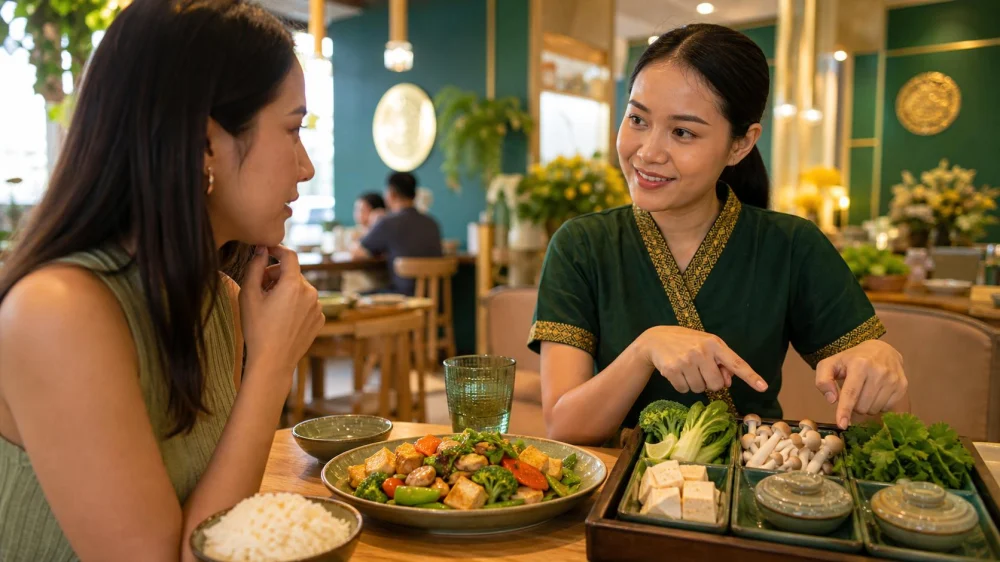
How to Ask if a Thai Dish Is Truly Vegetarian
On this page
- Quick answer
- Define what vegetarian means to you
- Ask about hidden animal ingredients
- Check premixed pastes, stocks, and sauces
- Discuss preparation and cross-contact
- Build a clear, simple order
- Vegetarian-order checklist
- Limitations and allergy notes
- Frequently asked questions
- Cuisine and allergy notes
- Use one complete question
Quick answer
Do not rely only on a vegetable icon or the word “tofu.” Tell the restaurant whether you avoid meat, poultry, fish, shellfish, fish sauce, oyster sauce, shrimp paste, animal stock, egg, dairy, or all animal products. Ask whether these ingredients are already in the curry paste, broth, sauce, seasoning, or garnish and whether the kitchen can prepare a separate version without them.
“Vegetarian,” “vegan,” and the Thai concept jay can overlap but are not interchangeable in every restaurant.
Define what vegetarian means to you
Some diners eat eggs or dairy; others do not. Some avoid visible meat but accept fish sauce; others require no animal-derived ingredients. State the ingredients you avoid rather than asking only, “Is this vegetarian?”
If you follow a strict religious, ethical, or medical practice, say what would make the dish unsuitable. A server can communicate a concrete list more reliably than a personal label whose meaning may vary.
Hi-So Thai
Weehawken TownshipHudson CountyNew Jersey
1903 Willow Ave A, Weehawken Township, NJ 07086, USA
Ask about hidden animal ingredients
Thai dishes can use fish sauce for salt and savoriness, oyster sauce in stir-fries, shrimp paste in curry paste or chili dip, dried shrimp in salads, seafood or meat stock in soup, and egg in noodles or fried rice. Toppings and table condiments may also contain animal ingredients.
Ask separately about the base and garnish. Removing shrimp from a finished dish does not remove shrimp paste, stock, or cross-contact, and ordering tofu does not automatically change the sauce.
Check premixed pastes, stocks, and sauces
Curry pastes, soup bases, seasoning powders, bottled sauces, and marinated proteins may be prepared before service. Ask whether the restaurant makes them in-house and whether staff can verify the label or recipe. A kitchen may be unable to remove shrimp paste from a premade curry paste.
Request an available vegetarian sauce or broth rather than asking the chef to “leave out everything.” Soy sauce, mushroom-based seasoning, salt, tamarind, lime, herbs, and aromatics may support an alternative, but the restaurant decides what it can prepare safely and well.
Discuss preparation and cross-contact
For a preference, you may accept shared woks, utensils, grills, fryers, or cooking oil. For an allergy, cross-contact can matter medically, so name the allergen and ask about shared equipment and surfaces. Do not describe an allergy as a preference.
Fish and shellfish are different allergen groups, and a person may need to avoid one or both according to their clinician's advice. A kitchen using fish sauce and shrimp paste throughout may not be able to control exposure adequately.
Build a clear, simple order
Call ahead at a quieter time and ask which dishes have a verified vegetarian base. At the table, repeat the restriction to the server and ask that it reach the cook. Choose a relatively simple dish when staff confidence is limited.
When the dish arrives, confirm it is the vegetarian order before tasting. Unexpected garnish, seafood odor, meat pieces, or a staff warning is a reason to pause and ask—not to remove the visible item and continue.
Vegetarian-order checklist
- State exactly which animal ingredients you avoid.
- Ask about fish sauce, oyster sauce, and shrimp paste.
- Check broth, curry paste, seasoning, and garnish.
- Confirm noodles, egg, and dairy if relevant.
- Distinguish preference from food allergy.
- Ask about shared woks, fryers, and utensils.
- Choose a verified dish the kitchen can execute.
- Confirm the order when it arrives.
Limitations and allergy notes
- Recipes, terminology, and kitchen controls vary.
- This guide cannot certify a dish as vegetarian, vegan, religiously compliant, or allergen-safe.
- People with fish or shellfish allergy should follow their allergist's dining guidance and carry prescribed emergency medication.
- For a suspected severe allergic reaction, follow the emergency plan and seek urgent medical help.
Frequently asked questions
Is tofu curry automatically vegetarian?
No. The curry paste, stock, fish sauce, shrimp paste, or garnish may contain animal ingredients.
Is oyster sauce vegetarian?
Traditional oyster sauce is animal-derived, though some restaurants use mushroom-based vegetarian alternatives. Ask which one is used.
Does “no fish sauce” make a dish vegan?
Not necessarily. Check shrimp paste, oyster sauce, stock, egg, dairy, and other ingredients.
What does jay mean?
It can refer to a Thai vegan religious food tradition with additional ingredient restrictions, but restaurant usage varies; confirm specifics.
Can the wok be cleaned for my order?
Ask what the kitchen can do. Cleaning may reduce residue but does not guarantee allergen control in every setup.
Cuisine and allergy notes
Thailand's official tourism materials illustrate how fish sauce, shrimp paste, fermented ingredients, seafood, and meat appear across regional dishes. Food Allergy Research & Education advises diners to ask about ingredients and preparation and notes that seafood-heavy kitchens can carry substantial cross-contact risk for fish or shellfish allergy.
Use one complete question
Ask: “Can this be made without meat, poultry, fish, shellfish, fish sauce, oyster sauce, shrimp paste, or animal stock, including the paste, broth, sauce, and garnish?” Add egg, dairy, allergy, and cross-contact requirements as needed.

 Hungry Thai (Southbury)0.0 (0 reviews)
 Mama's Thai Cuisine4.0 (183 reviews)
 Taste of Thai4.0 (188 reviews)
 Thai Lanna4.0 (581 reviews)
 Thai Station Restaurant4.0 (234 reviews)
 Daw Kun Thai4.0 (575 reviews)
 The Best Thai Food Restaurants in New York City for First-Timers
 Easy Make-Ahead Thai Food for Office Lunches
 Thai Food for Game Day: Crowd-Pleasing Dishes with a Thai Twist
 How to Make Thai Food That’s Cozy for Cold Winter Nights
 Thai Food & Travel Tips: What to Ask at the Restaurant in America
 Thai Food for Your Lunch Break: Quick & Healthy Recipes