
A Practical Guide to Essential Thai Herbs and Aromatics
On this page
- Quick answer
- What Thai aromatics do
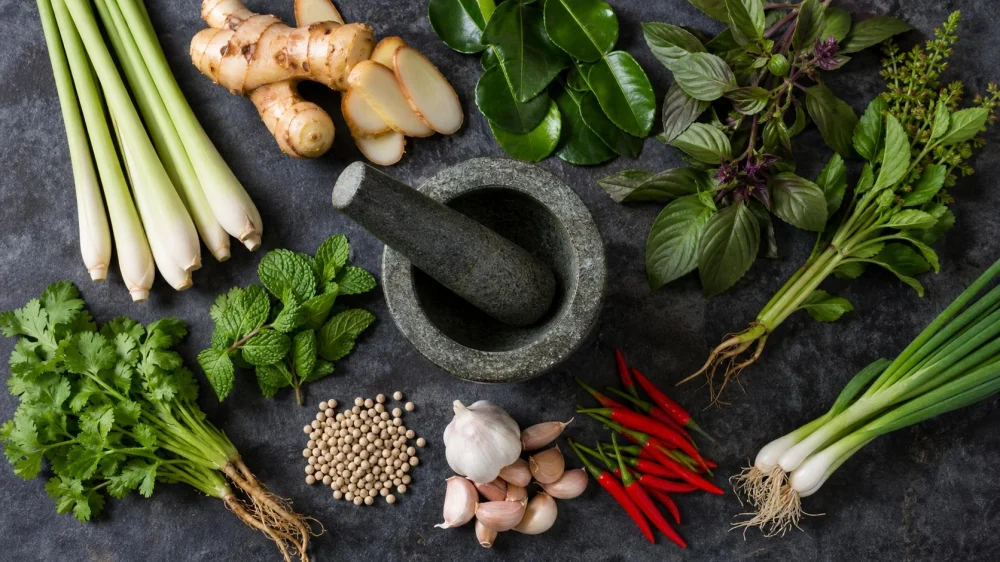
- Lemongrass and galangal
- Makrut lime leaves
- Thai basil and holy basil
- Cilantro roots, garlic, and pepper
- Mint, culantro, and green onions
- How to buy and store aromatics
- Substitution decision rules
- Frequently asked questions
- Evidence and cultural notes
- Conclusion and next steps
Quick answer
Thai cooking builds aroma in layers: sturdy ingredients such as lemongrass, galangal, lime leaves, garlic, and cilantro roots may be pounded into pastes or infused during cooking, while tender basil, mint, and cilantro are often added later. Learn each ingredient's job before substituting. The closest-looking herb is not always the closest flavor, and some aromatic pieces are removed rather than eaten.
An aromatic is an ingredient used primarily to create fragrance and flavor through pounding, frying, simmering, grilling, or fresh finishing.
What Thai aromatics do
Aromatics can form the foundation of curry pastes, season broths, perfume grilled foods, or brighten a finished salad. Their function depends on preparation. Bruised lemongrass in soup releases fragrance gradually; finely sliced tender inner lemongrass can become part of a salad; pounded lemongrass in a paste behaves differently again.
Names and availability vary across U.S. markets. When shopping, compare the physical ingredient and botanical or alternate name where available instead of relying only on an English shelf label.
Lemongrass and galangal
Lemongrass contributes a clean citrus-like aroma without functioning like lemon juice. Trim dry outer layers and the tough top according to the recipe. The pale lower portion is commonly bruised for infusion or sliced very finely when intended to be eaten.
Galangal is a firm rhizome with a piney, peppery, citrus-like character. It is related to ginger but does not taste the same. Slices in soup may be present for infusion and can remain fibrous; diners often move them aside. In curry paste, galangal is cut and pounded finely enough to become part of the paste.
Makrut lime leaves
Makrut lime leaves add an intense floral citrus fragrance to curries, soups, stir-fries, and pastes. Whole or torn leaves may be simmered for infusion, while very fine shreds can garnish certain dishes. Remove the tough central rib when the recipe calls for finely sliced leaves.
The leaves are not interchangeable with ordinary lime juice: the leaf supplies perfume, while the juice supplies acidity. A recipe may use both for different reasons. “Makrut lime” is a widely used contemporary English name; older retail labels may use another term.
Thai basil and holy basil
Thai basil commonly has a sweet, anise-like aroma and often tolerates brief cooking while retaining character. It appears in curries, noodle dishes, and stir-fries. Purple-tinged stems are common but appearance varies.
Holy basil, often associated with pad kra pao, has a distinct peppery, clove-like character. It is not simply a stronger version of sweet basil or Thai basil. U.S. restaurants and home cooks sometimes use another basil when holy basil is unavailable, but the result is an adaptation.
Add tender basil near the end and cook only as long as the recipe requires. Prolonged cooking can flatten its fresh aroma.
Cilantro roots, garlic, and pepper
Cilantro roots are valued for a deep earthy-citrus aroma and can be pounded with garlic and white peppercorns into a seasoning base for marinades, fried foods, soups, and other preparations. In U.S. stores, bunches are often sold without roots; lower stems are a practical but not identical alternative when a recipe author recommends them.
Garlic may be pounded raw, fried until aromatic, or turned into a crisp garnish. White pepper brings a different aroma from black pepper and is common in subtle savory seasoning. Technique matters: a pounded paste distributes flavor differently from roughly chopped ingredients.
Mint, culantro, and green onions
Mint brings cooling fragrance to salads, larb-style dishes, and fresh accompaniments. Culantro has long serrated leaves and a strong cilantro-like aroma; it may appear in regional soups and garnishes. Green onions and cilantro leaves frequently finish soups, rice dishes, and savory plates.
Wash fresh herbs in clean water, dry them well, and add them according to the recipe. For raw applications, keep herbs cold and prevent cross-contact with raw meat, seafood, and unwashed equipment.
How to buy and store aromatics
- Choose lemongrass with firm stalks and a fragrant, not dried-out, lower section.
- Look for firm galangal without extensive soft or moldy areas.
- Select lime leaves that are aromatic and not heavily browned.
- Choose basil and mint with lively leaves and no slimy decay.
- Ask Asian grocery stores about alternate names, frozen aromatics, or special ordering.
- Refrigerate fresh herbs appropriately and use them before deterioration.
- Freeze sturdy cleaned aromatics in recipe-ready portions when suitable; texture may soften, but they can remain useful for cooked dishes.
Substitution decision rules
- Identify the job. Is the ingredient supplying aroma, acidity, heat, color, bulk, or garnish?
- Preserve the dish's balance. Do not replace a fragrant leaf with extra acid or a rhizome with random citrus zest without considering the effect.
- Prefer omission over confusion. A clean adaptation may be better than stacking several substitutes that dominate the dish.
- Label adaptations honestly. Thai basil in a holy-basil dish can still be enjoyable, but it will not reproduce the same aroma.
- Adjust gradually. Taste when safe and add strong aromatics in controlled amounts.
Fresh or frozen authentic aromatics are best when the ingredient defines the dish. Substitution is more reasonable when it plays a supporting role and availability is limited. Follow a tested recipe rather than assuming equal-volume swaps.
Frequently asked questions
Can I eat lemongrass and galangal slices in soup?
They may be included mainly for infusion and can be fibrous. Unless finely prepared as an edible component, move tough pieces aside rather than forcing yourself to chew them.
Is galangal the same as ginger?
No. They are related rhizomes with different aromas, textures, and culinary roles. Ginger can create a good dish but does not exactly replace galangal.
Can lime zest replace makrut lime leaves?
It offers citrus aroma but not the same fragrance. Use a recipe-specific substitution and treat the result as an adaptation.
What basil belongs in pad kra pao?
Holy basil is the defining herb associated with the dish. Thai basil or another basil is sometimes used when holy basil is unavailable, changing the character.
Are curry paste aromatics eaten?
Yes, when properly trimmed, sliced, and pounded into the paste. Large infusion pieces placed directly in a soup are a different preparation.
Evidence and cultural notes
This glossary describes widely recognized culinary functions, but Thai cooking varies by region, household, restaurant, ingredient variety, and recipe. Transliteration also varies, so one Thai ingredient can appear under several English spellings. Use the recipe author's technique and the restaurant's description as the authority for a specific dish.
Conclusion and next steps
Start with four ingredients—lemongrass, galangal, makrut lime leaves, and one basil—and compare their aromas before cooking. Use Thai Food to explore dishes that feature each one, then follow a tested recipe or ask a restaurant how a house specialty uses them. Recognizing each aromatic's job makes menus clearer and home cooking more intentional.

 Tasty Thai4.0 (144 reviews)
 Bay (takeout Thai street food - please make a call for dine-in)5.0 (79 reviews)
 Money Tree Kitchen4.0 (269 reviews)
 Thai Eats5.0 (15 reviews)
 Ra-Kang Thai Cuisine4.0 (179 reviews)
 Bangkok Supper Club4.0 (565 reviews)
 Thai Food for Friends & Potlucks: Shareable Dishes That Always Win
 Thai Food Ingredient Spotlight: Palm Sugar vs Brown Sugar — Which Works Better?
 How to Make Thai Food That’s Perfect for Leftovers & Lunch Next Day
 Thai Food Near Me in Dallas: Best Crying Tiger Beef Spots Guide
 Thai Food for Game Day: Crowd-Pleasing Dishes with a Thai Twist
 Thai Food for the Fall Season: Warm Curries & Comfort Dishes